
Inbox Placement Rate vs. Open Rate: Measuring True Email Deliverability in 2026
In 2026, measuring true inbox placement rate is paramount, not open rates. Mail Privacy Protection (MPP) distorts open data, rendering it a vanity metric. Real inbox placement accounts for whether an email reaches the primary inbox, promotions, or spam. Tools like Adaptix, utilizing AI, can provide accurate deliverability-first insights, ensuring email marketing efforts are revenue-driving and efficient.
The Shifting Sands of Email Metrics: Why Open Rates No Longer Tell the Full Story

The email marketing metrics landscape has evolved, rendering traditional open rates unreliable. For decades, the open rate was a cornerstone metric, providing a straightforward measure of engagement. Marketers relied on it for subject line effectiveness, send times, and audience interest. However, recent technological advancements and privacy initiatives have fundamentally altered how these metrics are recorded. This shift necessitates a critical re-evaluation of performance assessment, pushing marketers to seek more robust indicators like true inbox placement rate. The challenge now lies in adapting to these changes and adopting sophisticated analytical approaches to truly understand campaign efficacy.
What Exactly is Mail Privacy Protection (MPP) and How Did It Break Open Rates?

Mail Privacy Protection (MPP), introduced by Apple in late 2021, enhances user privacy by preventing email senders from learning about recipients’ activity. MPP preloads email content, including tracking pixels, when an email is delivered to an Apple Mail user’s inbox, regardless of whether the user actually opens it. This automatic preloading triggers the tracking pixel, falsely registering an “open” event for every Apple Mail user. The impact on email marketing has been profound, inflating open rates across the board and making it impossible to distinguish genuine opens from system-generated ones for a significant portion of email subscribers.
Before MPP, an open rate reflected how many recipients viewed an email, making it critical for A/B testing, segmentation, and optimizing send times. Post-MPP, this metric is severely skewed. Marketers can no longer trust open rates to reliably inform segmentation strategies, measure subject line performance, or identify truly engaged subscribers. The data now includes substantial false positives, leading to misguided campaign optimizations, incorrect assumptions about audience engagement, and missed revenue opportunities. This fundamental change compels marketers to move beyond open rates and focus on more reliable deliverability-first metrics.
Beyond the Click: Unpacking True Inbox Placement Rate
True inbox placement rate focuses on where an email lands after being sent. This critical metric measures the percentage of emails that successfully reach a recipient’s intended inbox, differentiating between the primary inbox, promotional tabs, and the spam folder. Unlike open rates, which are distorted by privacy features like MPP, inbox placement provides concrete, actionable insight into your sender reputation and email infrastructure. It directly impacts whether your message is seen by the recipient at all, making it a cornerstone of any revenue-driving email marketing strategy.
Understanding true inbox placement means acknowledging that an email delivered to the promotions tab might be seen, but with less prominence than one in the primary inbox. An email delivered to spam is essentially lost. This distinction is vital for accurate email marketing success metrics. For example, a campaign with a high “open rate” (inflated by MPP) but a low primary inbox placement rate is performing poorly, even if numbers suggest otherwise. Conversely, a campaign with a moderate open rate but excellent primary inbox placement likely drives more meaningful engagement and conversions. This proactive approach ensures efficient email efforts and tangible results.
The Nuance of Deliverability: Primary Inbox vs. Other Folders
The distinction between an email landing in the primary inbox, a promotions tab, or the spam folder significantly impacts visibility and engagement. The primary inbox is the holy grail for email marketers, as messages here receive the highest visibility and are most likely to be read and acted upon. Algorithms used by major mailbox providers like Gmail, Outlook, and Yahoo constantly evaluate sender reputation, content relevance, and user engagement to determine this placement.
An email routed to a promotions tab reduces visibility. Recipients typically visit these tabs less frequently and often skim through them. The lowest rung is the spam folder, where emails are effectively dead on arrival, leading to zero engagement. Factors influencing these placements include sender score, content quality, HTML structure, subject line choices, link reputation, and historical recipient engagement. A robust deliverability-first strategy must actively monitor and optimize for primary inbox placement, understanding that even minor shifts can have major implications for campaign performance and ROI. This is where tools offering true inbox placement measurement become invaluable.
The Exact Math: How to Calculate and Track Real Inbox Placement in a Post-MPP World
Calculating true inbox placement rate in a post-MPP world requires moving beyond open rate metrics. Since direct open tracking is compromised, we rely on a combination of seed list testing, engagement metrics, and specialized deliverability tools. The fundamental goal is to determine the percentage of your sent emails that successfully bypass spam filters and land in the primary inbox or other intended folders.
Step 1: Define Your Seed List A seed list is a collection of email addresses across various internet service providers (ISPs) and mailbox providers (MBPs) – e.g., Gmail, Outlook, Yahoo, ProtonMail, AOL – that you control. These are test accounts designed to mimic your audience’s email environments.
Step 2: Send Test Campaigns Before or alongside your actual campaign send, dispatch a copy of your email to your seed list. This allows you to observe, in real-time, where your email lands across different inboxes.
Step 3: Analyze Seed List Placement For each email address on your seed list, record its destination:
- Primary Inbox
- Promotions/Updates/Social (for Gmail, etc.)
- Spam/Junk Folder
- Missing/Blocked (not delivered at all)
Step 4: Calculate Raw Inbox Placement Rate The basic calculation for inbox placement rate is:
$ \text{Inbox Placement Rate} = \left( \frac{\text{Emails in Primary} + \text{Emails in Promotions/Other Tabs}}{\text{Total Emails Delivered to Seed List}} \right) \times 100 $
Step 5: Calculate Primary Inbox Placement Rate (PIPR)
$ \text{Primary Inbox Placement Rate} = \left( \frac{\text{Emails in Primary Inbox}}{\text{Total Emails Delivered to Seed List}} \right) \times 100 $
This is the most critical metric for understanding your deliverability effectiveness. A high PIPR indicates strong sender reputation and content.
Step 6: Track Beyond the Seed List with Engagement (Post-MPP) Since MPP distorts open rates, focus on other engagement metrics from your actual subscribers:
- Click-Through Rate (CTR): The percentage of delivered emails that received at least one click. This is a robust indicator of genuine interest.
- Conversion Rate: The percentage of delivered emails leading to a desired action (e.g., purchase, sign-up, download).
- Unsubscribe Rate: A key indicator of recipient satisfaction; high rates can negatively impact deliverability.
- Complaint Rate: The percentage of recipients marking your email as spam. Even a small number can severely damage sender reputation.
By integrating data from seed list testing with actual subscriber engagement (CTR, conversions), you get a comprehensive view of post-MPP email analytics. For example, if your PIPR is 90% but your CTR is low, it suggests your content or offer might need optimizing, not necessarily a deliverability issue. Conversely, a low PIPR indicates a fundamental deliverability problem.
Example Scenario:
You send an email campaign to 100,000 subscribers. Your seed list has 100 addresses.
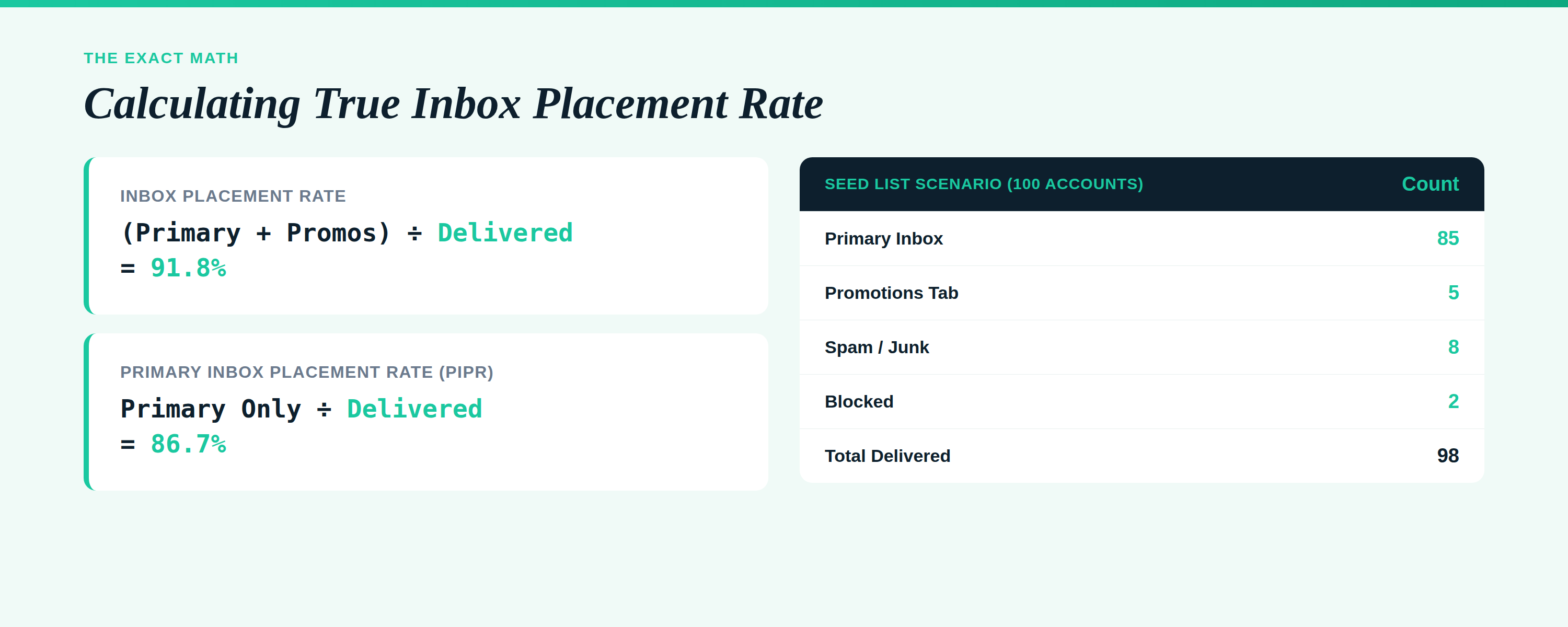
- 85 emails landed in the Primary Inbox
- 5 emails landed in Promotions
- 8 emails landed in Spam
- 2 emails were blocked
Using the formulas:
- Inbox Placement Rate: $((85 + 5) / 98) \times 100 = (90 / 98) \times 100 \approx 91.8%$ (considering 98 delivered to seed list, 2 blocked)
- Primary Inbox Placement Rate (PIPR): $(85 / 98) \times 100 \approx 86.7%$
This empirical breakdown provides a more accurate measure of true inbox placement measurement, allowing marketers to take targeted actions.
Implementing Adaptix: Autonomous Strategies for Maximizing Deliverability and Revenue

Adaptix offers a cutting-edge, autonomous platform designed to address the complexities of email deliverability in the post-MPP era, ensuring your email marketing efforts are revenue-driving. Our AI tools provide unparalleled insights and proactive measures to maximize your inbox placement rate, transforming uncertain email campaigns into efficient, high-performing communication channels. Adaptix’s deliverability-first approach focuses on intelligent automation and predictive analytics, protecting your sender reputation and optimizing every email send.
How Adaptix Enhances True Inbox Placement:
- AI-Powered Deliverability Monitoring: Adaptix continuously monitors your sender reputation and email performance across major ISPs using advanced AI algorithms. It provides real-time, precise true inbox placement measurement, showing you exactly where your emails land—primary, promotions, or spam—for a comprehensive overview.
- Predictive Guardrails and Anomaly Detection: Our platform leverages machine learning to identify potential deliverability issues before they impact your campaigns. Adaptix sets predictive guardrails, alerting you to unusual sending patterns, changes in bounce rates, or sudden drops in inbox placement, allowing for immediate corrective action. This proactive protection prevents critical deliverability setbacks.
- Automated List Hygiene and Segmentation: Clean, engaged lists are fundamental to good deliverability. Adaptix autonomously identifies and segments inactive subscribers, bounces, and potential spam traps, ensuring your sending lists are optimized. By automatically removing risky addresses and segmenting engaged users, Adaptix boosts your sender score and improves your chances of reaching the primary inbox, driving better email marketing success metrics.
- Content Optimization Guidance: Adaptix analyzes your email content for potential spam triggers and provides actionable recommendations to improve its deliverability. This includes advice on subject lines, HTML structure, link reputation, and image-to-text ratios, all designed to appeal to ISP algorithms and enhance primary inbox placement.
- Simplified Tracking and Reporting: The intuitive Adaptix dashboard offers clear, actionable reports on your deliverability performance. It demystifies complex data, presenting key metrics like Primary Inbox Placement Rate (PIPR), complaint rates, and engagement trends in an easy-to-understand format. This allows for efficient strategy adjustments, making your email marketing more scalable.
By leveraging Adaptix, brands can move beyond guesswork and manual processes, embracing an autonomous, deliverability-first strategy. This not only maximizes the reach and impact of email campaigns but also ensures that marketing spend translates into tangible revenue, making every email count.
Future-Proofing Your Email Strategy: What’s Next for Deliverability in 2026 and Beyond?
As we look towards 2026 and beyond, email deliverability will continue to evolve, driven by heightened privacy concerns, advanced AI in spam filtering, and shifting user behaviors. Future-proofing your email strategy means anticipating these changes and adopting a proactive approach to maintain high inbox placement rate. Sustained success will hinge on continuous monitoring, intelligent adaptation, and a deep understanding of evolving email marketing success metrics.
One significant trend is the increasing sophistication of mailbox providers’ algorithms. These algorithms will become even more adept at distinguishing between desired communication and unwanted spam, based on content, sender reputation, recipient engagement patterns, and domain authentication protocols (SPF, DKIM, DMARC). This means a pristine sender reputation, built on consistent positive engagement and minimal complaints, will be paramount. Any erosion of this reputation can lead to rapid shifts to the spam folder, making consistent true inbox placement measurement critical.
Privacy regulations are expected to become more stringent globally, potentially introducing new challenges for tracking and data collection. Marketers must prioritize ethical data practices and transparency, ensuring compliance while still gathering necessary insights for optimization. This will necessitate even greater reliance on first-party data and consent-based engagement strategies. The focus will shift further from quantity to quality, emphasizing personalized, relevant content that genuinely adds value.
Technologically, AI and machine learning will play an even larger role in deliverability management. Platforms like Adaptix, with their predictive analytics and autonomous capabilities, will become indispensable tools. They will not only monitor deliverability but also offer real-time, dynamic recommendations for content, send times, and audience segmentation to proactively optimize inbox placement. Protecting your email channel with robust deliverability-first solutions will no longer be an option, but a necessity for revenue-driving communication.
In conclusion, the era of open rates as a primary metric is definitively over. Marketers must embrace a deliverability-first mindset, focusing on true inbox placement rate as the definitive measure of email campaign success. By understanding the impact of MPP and leveraging advanced AI tools like Adaptix, you can navigate the complex email landscape of 2025 and beyond, ensuring your messages consistently reach their intended audience and drive real revenue.
Ready to transform your email deliverability from a challenge into a competitive advantage? Explore Adaptix today and discover how our autonomous AI platform can help you achieve unparalleled inbox placement and maximize your email marketing ROI.

Frequently asked questions
Why are email open rates considered a vanity metric after MPP?
Apple’s Mail Privacy Protection (MPP) pre-fetches email content, artificially inflating open rates for users with MPP enabled, regardless of whether they actually viewed the email. This makes open rate data unreliable for gauging user engagement or true deliverability, pushing marketers to focus on more accurate metrics like inbox placement rate.
What is the key difference between inbox placement rate and open rate?
Open rate historically measured if an email was opened, but MPP makes this unreliable. Inbox placement rate, conversely, measures the percentage of emails that successfully land in a subscriber’s intended inbox (primary, promotions, or updates) versus being blocked or routed to spam. It’s a deliverability-first metric indicating actual reach.
How can I accurately measure inbox placement in 2026?
Accurate inbox placement measurement in 2025 relies on sophisticated deliverability tools that use seed lists, third-party data, and AI-driven analysis. These tools send emails to a network of test accounts across various ISPs and report where the email landed. Combining this with engagement data (clicks, conversions) provides a holistic view, moving beyond the skewed open rate.
What role do AI tools like Adaptix play in post-MPP deliverability?
AI tools like Adaptix provide autonomous, deliverability-first solutions. They can predict potential deliverability issues, analyze historical campaign performance beyond open rates, and offer segmentation insights to optimize sending. This ensures email marketing remains revenue-driving and efficient by focusing on getting emails to the inbox effectively.
How does poor inbox placement impact my email marketing ROI?
Poor inbox placement directly harms email marketing ROI by reducing the number of subscribers who see your messages. If emails land in spam or are blocked, they can’t drive clicks, conversions, or engagement. This wastes marketing spend and dilutes the effectiveness of your segmentation and content efforts, making them less revenue-driving.

