
Marketing Fundamentals: Frameworks, Channels, and How to Build a System That Works
Marketing changes fast. The fundamentals don’t.
Trends come and go (new platforms, new ad formats, new algorithms), but the foundations that make marketing effective stay the same: understand people, create value, communicate it clearly, deliver a good experience, and learn faster than competitors.
This guide pulls the major “fundamentals” frameworks together in one place (4 Ps, 5 Ps, 7 Ps, and the 5 Ds), explains how they fit, and shows how to operationalize fundamentals into a repeatable system you can run in Adaptix.
What Marketing Actually Is
Marketing is the system your business uses to:
- Understand demand (who wants what, and why)
- Shape perception (positioning, differentiation, trust)
- Create preference (value communication and proof)
- Drive action (conversion and purchase)
- Build retention (repeat use, loyalty, advocacy)
Promotion is just the visible part. The fundamentals include research, strategy, execution, measurement, and iteration.
The one universal truth: diminishing returns
Every channel and tactic hits diminishing returns:
- audiences fatigue
- costs rise
- competitors copy you
- novelty fades
Fundamentals matter because they create a system for continuous improvement, not one lucky campaign.
The Core Marketing System: Research → Strategy → Execution → Measurement → Improvement
If you want a “forever” marketing foundation, this is it.
1) Research (customer + market truth)
Research means you can answer:
- Who are we for?
- What problem are we solving?
- What alternatives do customers compare us to?
- What triggers a decision?
- What objections stop a decision?
Sources of research:
- interviews and surveys
- sales calls and objection logs
- support tickets and reviews
- win/loss analysis
- competitor positioning and pricing pages
2) Strategy (choices, not activity)
Strategy is deciding:
- who you will target first
- which message angle will win
- where you will show up (channels)
- what “success” means (KPIs and outcomes)
Strategy is about focus. Without focus, you get “marketing busywork.”
3) Execution (consistent value delivery)
Execution means:
- campaigns and content that match the stage of the buyer
- consistent messaging across touchpoints
- cadence that builds trust instead of burning attention
4) Measurement (signals that you trust)
Track outcomes and guardrails:
- outcomes: leads, demos, sales, retention
- guardrails: bounces, complaints, unsubscribes, CAC, ROAS, churn
5) Improvement (experiments, not guesses)
Fundamentals don’t say “change constantly.” They say:
- test one meaningful change
- measure impact
- keep what works
- repeat
That is how you beat diminishing returns.
The Marketing Mix Frameworks: 4 Ps, 5 Ps, and 7 Ps
These models all try to answer the same question:
What must be true for marketing to work?
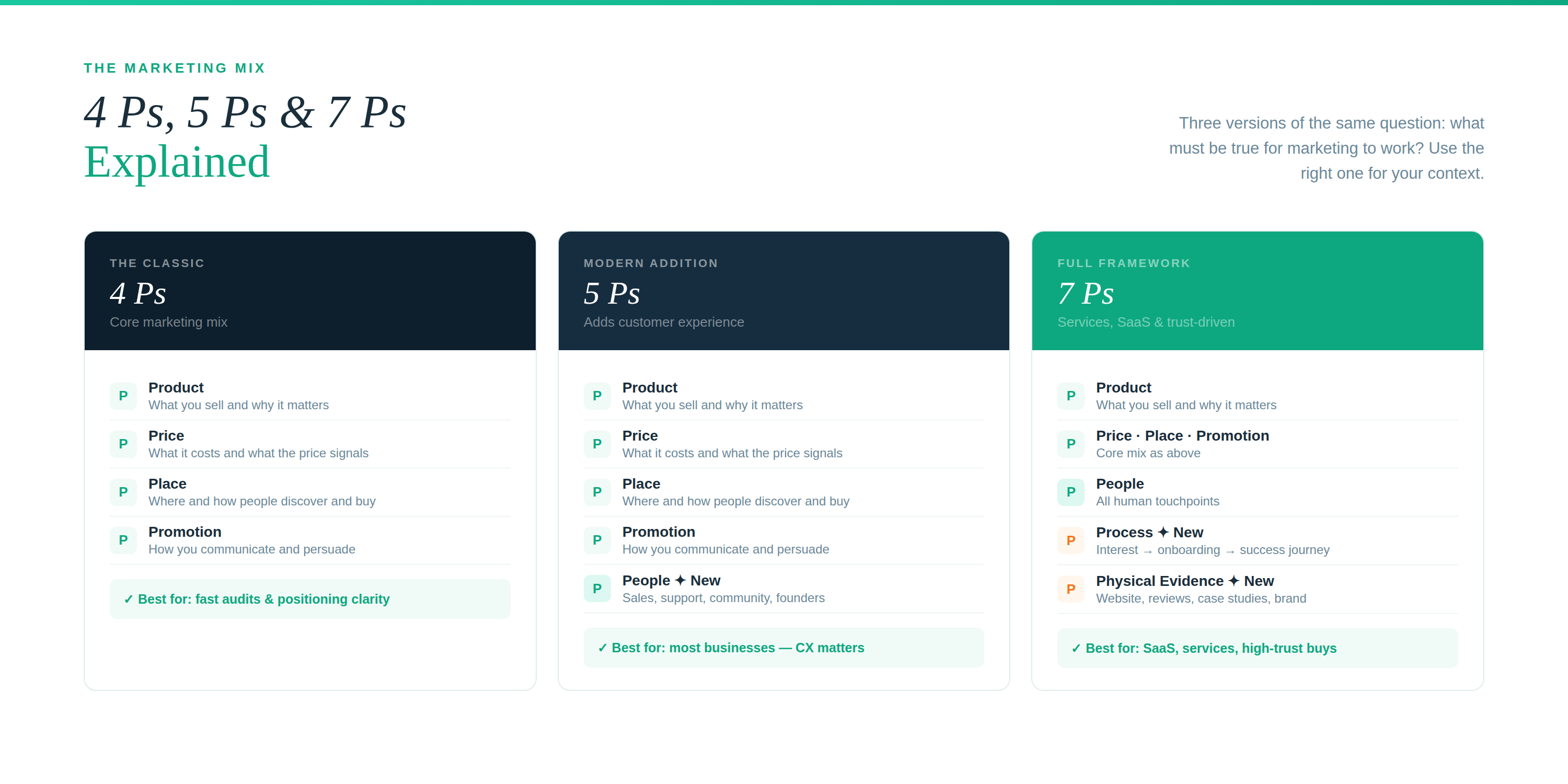
The difference is how complete you want the checklist to be.
The 4 Ps of Marketing
The classic marketing mix is:
- Product: what you sell and why it matters
- Price: what it costs and what the price communicates
- Place: where and how people discover and buy
- Promotion: how you communicate and persuade
This is the smallest usable set. It’s great for clarity and quick audits.
The 5th P: People
Modern marketing adds People because:
- customers judge brands through experiences with humans
- one bad interaction can become public instantly
- influencers, founders, sales, and support are part of the brand
People includes:
- sales conversations
- customer support
- community presence
- partners and spokespersons
If your product is strong but people/process are weak, marketing spend gets wasted.
The 7 Ps (common in services and modern business)
The 7 Ps expand further:
- Product
- Price
- Place
- Promotion
- People
- Process
- Physical Evidence
Process: how someone goes from interest to success (onboarding, delivery, refunds, support).
Physical Evidence: tangible signals of trust (website quality, reviews, case studies, brand consistency, packaging).
Why 7 Ps matter:
- Digital-first businesses often “sell” intangible value.
- Buyers need signals that reduce risk.
- Process and proof are what turn interest into confidence.
Which P framework should you use?
Use them like this:
- 4 Ps: fast marketing audit and positioning clarity
- 5 Ps: when customer experience and reputation matter (most businesses)
- 7 Ps: when trust, service delivery, and perceived risk are major buying factors (SaaS, services, healthcare, finance, education)
The 5 Ds of Digital Marketing (and why they’re worth knowing)

The 5 Ds aren’t a “marketing mix” like the Ps. They’re a modern way to think about the digital environment your marketing operates inside.
That’s why they’re useful, even if they’re not as classic as the Ps.
The 5 Ds are:
- Digital Devices
- Digital Platforms
- Digital Media
- Digital Data
- Digital Technology
1) Digital Devices
People experience your brand through devices: phones, tablets, desktop, TV, even wearables.
Fundamental implication:
- Your message must be readable and compelling on mobile first.
- Your conversion paths must be frictionless on the device people actually use.
2) Digital Platforms
Search engines, social networks, email inboxes, marketplaces, and websites are “platforms.”
Fundamental implication:
- Every platform has different rules, algorithms, and audience expectations.
- “Repurpose everything everywhere” often fails because platforms reward native behavior.
3) Digital Media
Media is the format: text, video, images, audio, interactive content.
Fundamental implication:
- Different formats convey trust differently.
- Video might build belief; text might capture intent; email might build relationship.
4) Digital Data
Digital is measurable. That’s a superpower and a trap.
Fundamental implication:
- You can measure lots of things, but you need to choose the signals that matter.
- If you optimize the wrong metric (clicks instead of conversions), you’ll grow activity, not results.
5) Digital Technology
The tools: automation platforms, analytics, CRMs, CDPs, attribution, creative tools.
Fundamental implication:
- Tools don’t create strategy, but they can enforce consistency, speed, and learning.
- The right tech stack makes fundamentals easier to execute and measure.
Why the 5 Ds matter alongside the Ps
- The Ps help you design the offer and market fit.
- The Ds help you execute and distribute in a digital world.
Together they explain why “good marketing” is both product/positioning and execution/measurement.
The Fundamentals Behind Any Channel
Channels are not fundamentals. But fundamentals show up inside each channel.
Here’s how to think about the major types you mentioned through a fundamentals lens.
B2B vs B2C
- B2C: scale, emotion, convenience, brand familiarity
- B2B: trust, risk reduction, multiple stakeholders, longer cycles
Fundamental difference:
B2B marketing often wins through clarity + proof + consistent follow-up more than flashy creative.
Inbound vs Outbound
- Inbound: earns attention (content, SEO, community)
- Outbound: initiates attention (cold email, calls, targeted outreach)
Fundamental rule:
Outbound must lead with relevance and value or it becomes spam. Inbound must be consistent or it never compounds.
Content, SEO, Email, Social
- SEO/content capture intent and compound over time.
- Email builds relationship and enables testing with clean measurement.
- Social builds familiarity and trust through repetition and narrative.
Fundamental rule:
No channel saves a weak offer or unclear positioning. Channels amplify what’s already true.
How to Build a Marketing Strategy Using Fundamentals
Here’s a practical strategy flow that maps to the fundamentals and avoids “random acts of marketing.”

Step 1: Define your audience and job-to-be-done
Answer:
- Who is this for?
- What are they trying to accomplish?
- What makes them choose one option over another?
Step 2: Write your value proposition (in one sentence)
Template:
For [audience], [product] helps you [outcome] by [unique mechanism], unlike [alternative].
Step 3: Choose your channel mix with the 5 Ds in mind
- Where are your customers already paying attention?
- Which device/platform combinations matter most?
- Which format will carry belief fastest?
Step 4: Build a simple funnel
- Awareness: content/social/search presence
- Consideration: proof, education, comparison
- Decision: offer, CTA, risk reduction
- Retention: onboarding, success, upsell
Step 5: Decide what you will measure and what you will protect
Measure:
- the outcome KPI (sales, bookings, trials)
Protect: - deliverability, brand trust, CAC, churn, unsubscribes
Step 6: Run experiments
Create a backlog:
- message angles
- segments
- offers
- landing page changes
- cadence and timing
Test one meaningful change at a time.
How Adaptix Helps You Execute Marketing Fundamentals
Adaptix supports the fundamentals by helping you turn strategy into a repeatable system.
Apply the “Research → Execution” loop faster
- Use contact and campaign activity to learn what topics, CTAs, and segments respond.
- Turn insights into new segments and targeted sends rather than one-size blasts.
Operationalize segmentation and relevance
- Segment lists so different audiences get different messages.
- Keep cadence appropriate by sending to engaged groups first, then expanding.
Build consistency with campaigns and automations
- Create structured sequences that match funnel stages (welcome, nurture, re-engagement).
- Use forms to capture leads and route them into the correct starting point.
Measure and iterate
- Use key metrics to identify what worked.
- Adjust messaging and targeting based on results instead of “sending because it’s time.”
The practical payoff: fewer wasted sends, clearer signals, and better compounding over time.
FAQ
What are marketing fundamentals
Marketing fundamentals are the core principles that guide effective marketing in any channel: understanding customers, creating value, positioning clearly, delivering consistently, and improving through measurement and testing.
What’s the difference between the 4 Ps, 5 Ps, and 7 Ps
They’re versions of the marketing mix. The 4 Ps are the core. The 5th P adds People. The 7 Ps add Process and Physical Evidence, which are critical for services, SaaS, and trust-based buying.
What are the 5 Ds of digital marketing
Digital Devices, Digital Platforms, Digital Media, Digital Data, and Digital Technology. They help marketers understand how digital distribution and measurement work in practice.
Are the 5 Ds “better” than the Ps
No. They solve different problems. The Ps help design the market offer. The Ds help execute in a digital world.
Why do marketing strategies stop working
Diminishing returns. Audiences fatigue, competition increases, costs rise, and the novelty wears off. Continuous testing and iteration are the antidote.
How can Adaptix help with marketing fundamentals
Adaptix helps you segment audiences, run campaigns and automations, capture leads with forms, measure results, and iterate faster so your marketing system improves over time.
