
How to Use Adaptix for AI-Driven Lead Generation
A practical guide to capturing, nurturing, and converting leads using Adaptix’s marketing automation platform — from first form fill to closed revenue.
Published by the Adaptix Team · March 2026
Most businesses treat lead generation as a volume problem. More traffic, more form fills, more contacts in the database. But volume without structure produces lists that sit idle, sequences that go unanswered, and a sales team that has stopped trusting the leads marketing sends over.
The real problem is usually not the number of leads. It is what happens — or does not happen — after a lead enters your system. Inconsistent follow-up, generic messaging, poor timing, and no clear way to distinguish a serious prospect from a casual browser. These are process failures, and they are fixable.
Adaptix is a marketing automation platform built to address exactly this. It gives marketing and sales teams the tools to capture leads intelligently, nurture them through behavioral automation, score them based on engagement, and measure what actually drives revenue. This guide walks through how each part of the platform contributes to a stronger lead generation program.
What Adaptix Is — and What It Is Not
Before covering the tactical how-to, it helps to set expectations about what Adaptix does. It is a deliverability-first marketing automation platform that combines email marketing, SMS, automation flows, landing pages, forms, segmentation, and analytics into a single workspace. Its AI tools — Send Time Optimization, Subject Line Helper, and Spintax — are embedded directly into the campaign and automation builder.
What it is not: a prospecting database, a cold outreach tool, or a sales intelligence platform. Adaptix works with the leads and contacts you already have or are actively capturing. Its strength is in what happens after a lead enters your funnel — the nurture, the qualification, the conversion, and the measurement of all of it.
Why this distinction matters A lead generation program built on Adaptix assumes you have some mechanism for drawing people into your funnel — paid media, organic content, events, referrals, or partnerships. Adaptix handles everything from the capture point forward, and it handles that part exceptionally well. |
Lead Capture: Forms, Landing Pages, and List Segmentation

The first functional piece of lead generation in Adaptix is the capture layer: forms and landing pages. Both are built with a no-code drag-and-drop editor, which means marketing can publish a campaign page, embed a lead form, or launch a pop-up without submitting a ticket to development.
Forms that segment as they capture
Forms in Adaptix do more than collect contact information. They can be configured to segment contacts into specific lists or audiences at the moment of submission, based on the fields completed, the page the form appeared on, or other behavioral context available at capture time. A lead who fills out a form on a product-specific landing page can be routed directly into a nurture flow built for that product category — automatically, without any manual sorting afterward.
This matters because the quality of a lead nurture program depends on the relevance of what follows. A contact who expressed interest in one service should not receive generic content about everything you offer. Segmentation at capture is the first step toward personalized follow-up at scale.
Landing pages built for conversion
Landing pages in Adaptix are built to stand alone — they do not require an existing website to function. You can create a dedicated page for a campaign, point paid traffic at it, embed a lead form, and have the entire capture-to-nurture pipeline running within the same platform. For businesses running multiple campaigns across different offers or audiences, this eliminates the need to coordinate page builds across separate tools.
Pop-up and embed options extend capture to existing web properties without page rebuilds. A timed pop-up on a high-traffic blog post, a sticky bar on a product page, or an embedded form in a resource download flow can all be created and managed from inside Adaptix.
Lead Nurturing: Automation Flows Built for Conversion
Capturing a lead is only the beginning. The majority of leads — regardless of industry or offer — are not ready to buy at the moment they first engage. They are researching, comparing options, or exploring whether they even have the problem your product solves. A nurture program bridges that gap between initial interest and purchase decision.
Adaptix’s automation flow builder is the central tool for this. It uses a visual canvas where you drag and connect steps: triggers, conditions, wait windows, email sends, SMS messages, list updates, lead score adjustments, and goal completions. The result is a journey that responds to how a contact actually behaves, rather than advancing everyone on the same fixed schedule.
Trigger-based entry
Flows in Adaptix are triggered by contact behavior, not by a manual send. A contact who fills out a form enters the welcome flow automatically. A contact who clicks a specific link in an email can be branched into a more targeted sequence. A contact who has not opened anything in 90 days can enter a re-engagement flow. The automation responds to what the contact does, not what you remember to send.
Splits, goals, and time-decay scoring
Within a flow, conditional splits allow you to send different content to different segments of the same audience. Contacts who have engaged with multiple emails can receive a more direct offer. Contacts who have not opened yet can receive a re-subject or a plain-text follow-up. Goal steps let you end a flow when the desired outcome is reached — a purchase, a demo booking, a trial activation — so a contact who converts is not still receiving introductory content three days later.
Time-decay lead scoring is built into the flow logic. Engagement points — email opens, link clicks, form fills, page visits — contribute to a contact’s score over time, and that score decays if engagement drops off. This gives you a dynamic view of which contacts in your database are currently active and interested, rather than a static snapshot of what they did when they first signed up.
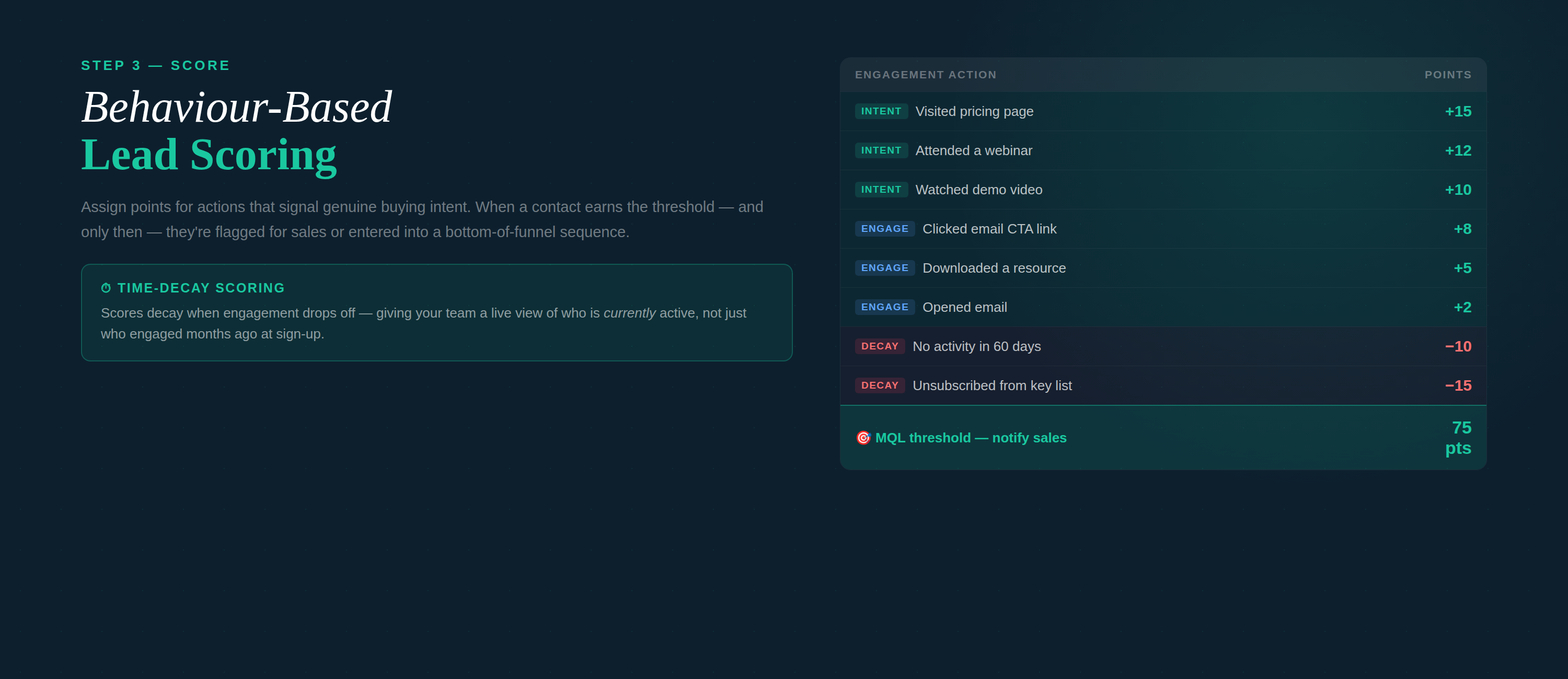
Lead Scoring in Practice A contact who clicks through a product email, then visits your pricing page, then opens a follow-up within 48 hours is showing a different level of intent than a contact who opened one email six weeks ago. Adaptix’s scoring logic captures that difference and surfaces it so your team knows where to focus. |
AI Tools: Where the Platform Gets Smarter Over Time

Adaptix includes three native AI tools that are embedded directly into the campaign and automation workflow. They are not separate modules that require separate configuration — they appear inside the editor where you are already working.
Send Time Optimization
Send Time Optimization analyzes engagement data to identify the window when each individual contact is most likely to open and interact with a message. Rather than selecting a fixed send time based on general best-practice guidelines — which represent an average, not your specific audience — the platform schedules each send to align with each contact’s actual engagement patterns.
For lead nurture campaigns in particular, this changes the dynamic considerably. A nurture email arriving at the moment a prospect is most likely to engage gets a genuinely different result than the same email arriving during off-hours and getting buried. Timing is a lever that most teams leave at a fixed position. Send Time Optimization adjusts it continuously.
Subject Line Helper
Subject lines determine whether a lead generation email gets opened or ignored. The Subject Line Helper analyzes your draft subject lines and provides feedback on likely open performance, offering variations that address common engagement factors: clarity, specificity, curiosity, and relevance to the recipient’s stage in the funnel.
This is useful not just for broadcast campaigns but for the individual emails inside your automation flows — the ones that fire when a contact takes a specific action or reaches a specific score threshold. These emails often receive less copy attention than a major campaign, and they are frequently the ones that either close the loop or lose the lead.
Spintax for Dynamic Content Variation
Spintax allows you to define multiple versions of a phrase, sentence, or section within a single email template. The platform selects from those variations when sending, producing a range of slightly different messages from one template. This reduces the signature of high-volume sends — a common factor in deliverability degradation — and allows for personalization across large lists without building individual templates for each variant.
For lead generation programs running at scale, Spintax is particularly valuable in first-touch outreach and re-engagement campaigns where message fatigue and spam filter sensitivity are both concerns.
Deliverability: The Infrastructure Under the Lead Program
Lead generation email programs fail when messages do not reach the inbox. Spam folder placement, domain blacklisting, and poor sender reputation are the silent killers of otherwise well-constructed campaigns. Adaptix treats deliverability as a platform-level responsibility, not something you configure once and forget.
Authentication and domain health
The platform provides guided setup and alignment checks for SPF, DKIM, and DMARC — the three authentication standards that inbox providers use to evaluate whether your email is legitimate. Without proper alignment across all three, even well-crafted messages land in spam or get rejected entirely. Adaptix walks through this configuration and surfaces misalignments before they affect deliverability.
Ongoing domain and IP health monitoring runs in the background, checking against blacklists and providing health scorecards. If your sender reputation trends in the wrong direction, you see it early rather than discovering it after a campaign has already underperformed.
List hygiene and bounce management
Bounce rates and spam complaint rates above certain thresholds trigger automatic pauses in Adaptix. This prevents a deliverability problem from compounding — a flood of hard bounces from a stale list segment can damage your domain reputation within a single send if left unchecked. The platform enforces guardrails that protect the health of your sending infrastructure.
List hygiene tools help identify and remove problematic addresses before they become a deliverability issue. Duplicate detection, invalid address flagging, and compliance-aware segmentation filters keep your active contact pool clean and ensure your metrics reflect real engagement rather than noise.
Why This Connects to Lead Generation A lead generation email program is only as effective as its inbox placement rate. A technically strong campaign that lands in spam does not generate leads. Deliverability infrastructure is not a separate concern from lead generation strategy — it is a prerequisite for the strategy to work. |
Segmentation: Sending the Right Message to the Right Person
Adaptix’s segmentation tools allow you to divide your contact database into audiences based on demographic data, firmographic data, behavioral data, and lead score. Segments can be static — a fixed list you define once — or dynamic, updating automatically as contacts meet or fall out of the defined criteria.
For a lead generation program, segmentation does two things. First, it makes outbound campaigns more relevant by ensuring that each group receives content calibrated to where they are in the consideration process. A contact who attended a webinar six months ago and has not engaged since receives different content than a contact who downloaded a case study last week. Second, it protects your non-engaged contacts from over-messaging, which is a common cause of unsubscribes and complaint rate increases.
Behavioral segmentation from your automation flows
As contacts move through your automation journeys, their behavior creates data that Adaptix uses to update their segment membership and lead scores. A contact who clicks every link in a nurture sequence and visits your pricing page is automatically recategorized as high-engagement. This creates a pipeline of warm leads that your team can act on — contacts who have demonstrated real interest, not just initial opt-in.
Personalization within campaigns
Adaptix supports block-level personalization inside a single campaign send. You can define which content blocks appear to which segments, so one email send to your full list delivers different messaging to different audiences — without building separate campaigns for each. A promotional campaign can emphasize different use cases for a small business contact versus an enterprise contact, using the same send and the same subject line test pool.
Multichannel Lead Nurture: Email and SMS Working Together
Adaptix manages email and SMS from the same flow canvas. This is not a minor convenience feature — it changes how you can design a nurture program. Rather than running separate email and SMS platforms with separate logic and separate contact lists that require manual synchronization, both channels respond to the same triggers and share the same contact data.
For lead generation, this matters in several practical scenarios. A contact who opts in via a mobile form can receive an immediate SMS confirmation, followed by an email with more detailed content, followed by SMS reminders if the email goes unopened. High-priority leads who reach a score threshold can receive a direct SMS from a sales-assigned number without any manual intervention. Re-engagement campaigns can test whether a contact who has stopped opening email will respond to an SMS before the contact is archived.
The important constraint is compliance. Adaptix supports TCPA and GDPR-aligned consent collection and documentation, and SMS sends should only go to contacts who have explicitly opted in for text communications. The platform’s list management tools make it straightforward to maintain separate consent records for email and SMS.
Reporting and Revenue Attribution: Measuring What Matters
The most common failure mode in lead generation reporting is measuring activity rather than outcomes. Open rates, click rates, and form fills tell you whether your campaigns are generating engagement. They do not tell you whether they are generating revenue.
Adaptix’s reporting includes revenue attribution at the campaign and segment level, which means you can tie a specific automation flow or broadcast campaign to the pipeline and closed revenue it generated. This gives marketing a defensible answer to the question that sales and leadership always ask: what is this actually producing?
Campaign, flow, and cohort views
The reporting interface provides three levels of analysis. Campaign views show performance for individual sends — open rate, click rate, conversions, and revenue attributed. Flow views show how contacts are moving through automation journeys, where they are dropping off, and what conversion rates look like at each goal step. Cohort views allow you to track groups of contacts over time — for instance, all contacts who entered a nurture flow in a given month — and compare their long-term conversion behavior against other cohorts.
A/B testing without rebuilding
Adaptix supports A/B testing at the campaign level and within flows. Subject line tests, content variation tests, and send time tests can be run against a portion of your audience before the full send goes out. The winning variant is sent to the remainder automatically. For teams that want to continuously improve lead generation performance, this creates a systematic way to learn what works with your specific audience rather than relying on general industry benchmarks.
Integrations: Connecting Adaptix to Your Existing Stack
Adaptix integrates with the tools most lead generation programs rely on. Native integrations include Salesforce, HubSpot, Shopify, Stripe, Zapier, Twilio, and over 30 additional platforms for contact and event data. Webhook support extends connectivity to custom systems.
The practical implication is that leads captured in Adaptix can be pushed to your CRM automatically, with the contact record enriched by the behavioral data Adaptix has collected — lead score, last engagement date, flow history, segment membership. Sales reps receive contacts who have a documented history with your content, not just a name and an email address.
For e-commerce businesses using Shopify, purchase events trigger and update flows in real time — a new customer enters an onboarding flow automatically, a lapsed customer enters a win-back flow after a defined period of inactivity. The data connection removes the manual step that most marketing teams build workarounds for.
Building a Lead Generation Program in Adaptix: A Practical Framework

Given the tools available, here is how a functional lead generation program in Adaptix typically comes together.
Step 1: Set up your capture infrastructure
Build the forms and landing pages that will bring contacts into your database. Configure segmentation rules so that each form submission routes the contact to the appropriate list or flow entry point. Enable double opt-in if your audience or compliance requirements call for it.
Step 2: Build your core automation flows
Start with three flows that address the highest-leverage moments in your funnel: a welcome flow for new contacts, a lead nurture flow for contacts who have engaged but not converted, and a re-engagement flow for contacts who have gone quiet. These three cover the majority of lead lifecycle situations and give you a foundation to build from.
- Welcome flow: confirms the opt-in, sets expectations, delivers the lead magnet or first value asset
- Nurture flow: sequences educational and social proof content, advances contacts toward a decision point, scores engagement
- Re-engagement flow: tests whether inactive contacts can be revived before they are removed from active sends
Step 3: Configure lead scoring
Define which actions indicate meaningful buying intent in your specific market and assign score values accordingly. Common scoring events include email link clicks, form fills, pricing page visits, webinar attendance, and content downloads. Set a threshold score at which a contact is flagged for sales follow-up or entered into a bottom-of-funnel sequence.
Step 4: Activate AI tools
Enable Send Time Optimization for your nurture flows to let the platform schedule sends around individual engagement windows. Use the Subject Line Helper when building new flow emails and campaign templates. Add Spintax to high-volume sends and re-engagement campaigns where message variation improves deliverability and response rates.
Step 5: Connect reporting to revenue
Configure revenue attribution before your first major campaign goes out. This requires connecting purchase or conversion data — via your Shopify integration, your CRM integration, or a webhook from your payment processor. With attribution in place, every subsequent campaign and flow reports on pipeline and revenue, not just engagement.
The Underlying Principle
Lead generation is not a single tactic. It is a system — capture, nurture, score, convert, and measure — and each component of that system affects the others. A high-performing capture layer loses its value if the nurture program that follows it is generic. A well-designed nurture program loses its value if it never reaches the inbox. Detailed scoring data loses its value if there is no workflow to act on it.
Adaptix brings all of these components into one platform and connects them. The result is a lead generation program where each action produces data that improves the next action — forms that feed segmented flows, flows that produce scoring data, scoring data that informs personalization, and personalization that drives measurable revenue outcomes.
For marketing teams that want a tighter loop between their lead generation investment and their revenue results, this is where to start.
