
Customer Feedback Survey Guide: Best Practices to Improve CSAT, Trust, and Retention
Customer feedback surveys are one of the fastest ways to understand what your customers actually think about your business, products, and support experience. When done well, a customer feedback survey helps you uncover friction, improve customer satisfaction, reduce churn, and make smarter marketing and service decisions.
The problem is not whether businesses collect feedback — most do. The real issue is whether they collect the right feedback, from the right audience, at the right time, and then actually act on it.
In this guide, you’ll learn:
- What a customer feedback survey is
- Why customer feedback surveys matter
- The most effective survey question types
- Best practices to increase response quality and response rates
- Common mistakes to avoid
- How to use Adaptix to automate customer feedback surveys and follow-up workflows
If your goal is to improve customer experience, increase retention, and build stronger customer relationships, this is where to start.
What Is a Customer Feedback Survey?
A customer feedback survey is a structured set of questions used to collect customer opinions, ratings, and comments about their experience with your company, product, service, or support team.
A customer feedback survey can be used to:
- Measure satisfaction after a purchase or support interaction
- Identify friction in onboarding or product usage
- Understand customer expectations and sentiment
- Gather suggestions for product improvements
- Track customer loyalty and retention risk over time
These surveys can be sent through multiple channels, including:
- In-app messages
- Website popups
- SMS
- Post-support follow-ups
- Landing page forms
The best customer feedback surveys combine quantitative data (ratings, multiple choice, yes/no) with qualitative feedback (open-ended responses) so you can understand both the score and the reason behind it.
Why Customer Feedback Surveys Matter
A business can’t improve what it doesn’t measure. Customer feedback surveys help replace guesswork with real customer insight.
1) Improve products and services
Surveys help you pinpoint what customers like, what frustrates them, and what needs improvement. This makes product and service decisions more data-driven and less opinion-based.
2) Increase customer satisfaction (CSAT)
When customers feel heard — and see that their feedback leads to improvements — satisfaction rises. This can directly improve loyalty and repeat business.
3) Reduce churn and improve retention
Exit surveys, low-CSAT follow-ups, and NPS detractor workflows can reveal the reasons customers leave before churn becomes a larger trend.
4) Make better business decisions
Survey insights can guide:
- Product roadmap priorities
- Support process changes
- Onboarding improvements
- Messaging adjustments
- Training needs for customer-facing teams
5) Strengthen customer relationships
Asking for feedback shows customers that their opinions matter. Following up on that feedback builds trust and long-term loyalty.
6) Track customer experience over time
Consistent surveys let you benchmark and compare changes across periods, campaigns, teams, or customer segments.
Customer Feedback Survey vs. Customer Satisfaction Survey
These terms are often used interchangeably, but they are slightly different:
- Customer feedback survey = broader category (includes product feedback, onboarding feedback, churn reasons, feature requests, and more)
- Customer satisfaction survey = specific type of feedback survey focused on measuring satisfaction (often using CSAT ratings)
In other words, CSAT surveys are one type of customer feedback survey.
The Most Common Types of Customer Feedback Surveys
Using the right survey type is just as important as asking the right questions.
1) CSAT (Customer Satisfaction) Surveys
Used to measure how satisfied a customer is with a recent experience (purchase, support interaction, onboarding step, etc.).
Example question:
“How satisfied were you with your experience today?”
(Scale: Very dissatisfied → Very satisfied)
Best for:
- Support follow-ups
- Purchase confirmation emails
- Onboarding milestones
- Service completion events
2) NPS (Net Promoter Score) Surveys
Used to measure customer loyalty and likelihood to recommend your business.
Example question:
“How likely are you to recommend us to a friend or colleague?”
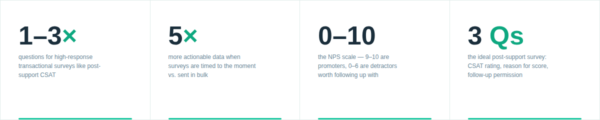
(Scale: 0–10)
Best for:
- Quarterly customer health checks
- Account reviews
- Long-term retention programs
- Segmenting promoters/passives/detractors for follow-up
3) CES (Customer Effort Score) Surveys
Used to measure how easy or difficult it was for a customer to complete an action.
Example question:
“How easy was it to resolve your issue today?”
(Scale: Very difficult → Very easy)
Best for:
- Support resolution feedback
- Self-service/help center evaluation
- Onboarding task completion
- Checkout or form experience feedback
4) Post-Purchase Feedback Surveys
Focused on purchase experience, checkout flow, delivery expectations, or first impressions after buying.
Best for:
- Ecommerce
- Subscription signups
- Demo requests / consultation bookings
- Order completion workflows
5) Onboarding Feedback Surveys
Collect feedback early in the customer journey to improve activation and reduce drop-off.
Best for:
- SaaS onboarding
- Trial users
- New clients
- First 30-day experience checkpoints
6) Exit / Churn Surveys
Sent when a customer cancels, downgrades, or becomes inactive.
Best for:
- Retention analysis
- Win-back campaigns
- Identifying product/service gaps
- Competitive intelligence
Best Customer Feedback Survey Question Types (with Examples)
A high-performing customer feedback survey uses a mix of question formats. This gives you clean reporting data without losing customer context.
1) Rating Scale Questions (CSAT / Satisfaction)
These provide fast, measurable data you can trend over time.
Examples:
- How satisfied are you with your recent experience?
- How would you rate the quality of our support?
- How satisfied are you with our onboarding process?
2) NPS Questions (Loyalty)
These help identify promoters, passives, and detractors.
Example:
- How likely are you to recommend our company to a friend or colleague? (0–10)
Follow-up question:
- What is the primary reason for your score?
3) CES Questions (Effort)
These help you identify friction in tasks and workflows.
Examples:
- How easy was it to find the information you needed?
- How easy was it to complete your request?
- How easy was it to use this feature?
4) Multiple-Choice Questions
Great for pattern detection and easier analysis.
Examples:
- What was the main reason for your visit today?
- Which product feature do you use most often?
- What best describes your issue?
5) Yes/No (Binary) Questions
Helpful for quick qualification, but should be used sparingly.
Examples:
- Did we resolve your issue today?
- Did you find what you were looking for?
- Would you like a follow-up from our team?
6) Open-Ended Questions
These are critical for learning the “why” behind the score.
Examples:
- What could we improve?
- What stood out most about your experience?
- What nearly stopped you from completing your purchase?
- What would make this process easier next time?
Pro tip: Place open-ended questions after rating questions to gather context without increasing abandonment too early.
9 Best Practices for Creating a Customer Feedback Survey That Gets Better Responses
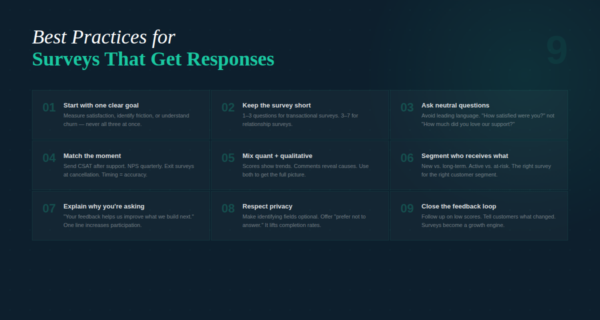
1) Start with one clear goal
Every survey should have one primary objective:
- Measure satisfaction
- Identify friction
- Understand churn
- Test a new experience
- Gather feature feedback
If you try to do everything in one survey, your data quality drops.
2) Keep the survey short
The best surveys are easy to complete. Focus on “need-to-know” questions, not “nice-to-know” questions.
A good rule:
- 1–3 questions for transactional surveys (post-support, post-purchase)
- 3–7 questions for periodic relationship surveys
3) Ask neutral, unbiased questions
Avoid leading questions like:
- “How much did you love our excellent support experience?”
Use neutral wording instead:
- “How satisfied were you with your support experience?”
4) Match the survey to the moment
Timing drives response quality.
Examples:
- Send CES immediately after task completion
- Send CSAT after a support interaction
- Send NPS on a quarterly cadence
- Send exit surveys at cancellation
When the experience is fresh, feedback is more accurate.
5) Use a mix of quantitative and qualitative questions
Scores show trends. Comments show causes.
A strong survey format often looks like:
- Rating question (CSAT/NPS/CES)
- Reason for score (open-ended or multiple choice)
- Optional follow-up / contact permission
6) Segment who receives which survey
Not every customer should get the same survey.
Segment by:
- Lifecycle stage (new vs long-term)
- Product usage
- Recent activity
- Support interaction type
- Customer tier/plan
- Region/language
This improves relevance and response rates.
7) Explain why you’re asking
A short line can improve trust and participation.
Example:
“Your feedback helps us improve the experience and prioritize what we build next.”
Customers are more likely to respond when they understand the purpose.
8) Respect privacy and make optional fields clear
If collecting demographic or identifying data:
- Explain why it’s needed
- Make non-essential fields optional
- Offer “Prefer not to answer” when appropriate
Privacy-conscious survey design improves completion rates and trust.
9) Close the feedback loop
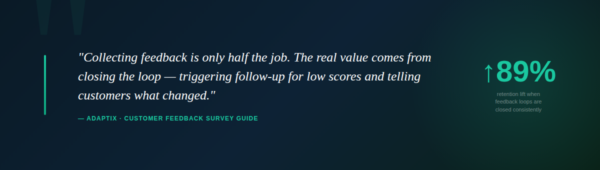
Collecting feedback is only half the job. The real value comes from action.
Best practice:
- Review trends regularly
- Route feedback to the right team
- Trigger follow-up for low scores
- Tell customers what changed based on their input
This turns surveys into a growth engine instead of a reporting exercise.
Common Customer Feedback Survey Mistakes to Avoid
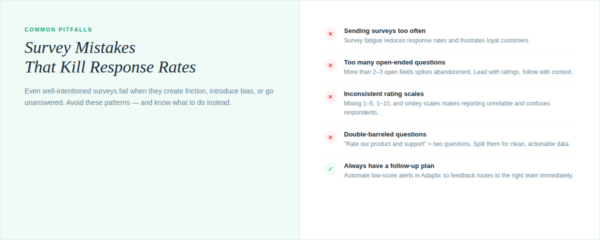
Even well-intentioned surveys fail when they create friction or bias. Avoid these common mistakes:
Sending surveys too often
Survey fatigue reduces response rates and can frustrate customers.
Asking too many open-ended questions
Open-ended questions are useful, but too many can increase abandonment.
Using inconsistent rating scales
Switching between different scales (1–5, 1–10, smileys, etc.) makes reporting harder and can confuse respondents.
Asking double-barreled questions
Example to avoid:
- “How satisfied are you with our product and support?”
This combines two separate experiences.
Collecting feedback with no follow-up plan
If no one reviews or acts on the data, surveys become noise — and customers stop responding.
Using survey scores only for punishment
Customer feedback should improve the customer experience and process quality. Overusing it as a blunt performance score can distort the data and reduce honesty.
How to Measure Customer Feedback Survey Performance
To improve your survey strategy, track survey performance metrics — not just customer scores.
Key survey metrics to track
- Delivery rate (email surveys)
- Open rate (email surveys)
- Click-through rate (email surveys)
- Survey start rate
- Completion rate
- Response rate
- Average score (CSAT, NPS, CES)
- Comment rate (how many leave qualitative feedback)
- Follow-up resolution rate (for low scores)
- Trend by segment (new customers, active customers, churn-risk customers)
Tracking these metrics helps you improve both the survey experience and the customer experience.
How Adaptix Helps You Build and Automate Customer Feedback Surveys
Adaptix can help businesses move beyond basic survey collection by connecting forms, automations, segmentation, and reporting into one workflow.
1) Create feedback surveys with flexible forms
Use Adaptix forms to build:
- CSAT surveys
- NPS surveys
- CES surveys
- Post-purchase feedback forms
- Exit/churn feedback forms
- Customer experience check-ins
You can keep surveys simple for high response rates or build more detailed forms when deeper feedback is needed.
2) Send surveys through automated email campaigns
With Adaptix automations, you can trigger surveys based on customer behavior and milestones, such as:
- After a support interaction
- After a purchase
- After onboarding completion
- After a demo
- After a set period of inactivity
- At renewal checkpoints
This helps you collect feedback when the experience is still fresh.
3) Segment audiences for more relevant surveys
Adaptix segmentation lets you send different surveys to different customer groups, for example:
- New customers vs returning customers
- Highly engaged vs at-risk users
- Customers by product usage
- Customers by lifecycle stage
- Customers by plan or account type
Better targeting = better response quality.
4) Route feedback for faster follow-up
You can use Adaptix automations and tags to trigger internal actions based on responses:
- Tag low CSAT respondents for follow-up
- Notify customer success or support teams
- Create recovery/win-back email sequences
- Trigger thank-you campaigns for promoters
- Route feature requests to product review queues
This helps close the feedback loop faster and improves customer trust.
5) Track trends and improve continuously
Adaptix reporting can help teams monitor:
- Response trends over time
- Satisfaction by segment
- Campaign performance for survey sends
- Engagement with follow-up workflows
- Which surveys produce the most actionable insights
The goal isn’t just to collect responses — it’s to turn feedback into actions that improve retention, customer satisfaction, and growth.
Customer Feedback Survey Example Structure (Simple and Effective)
Here’s a practical 3-question structure you can use for many use cases:
Example: Post-Support CSAT Survey
Q1 (CSAT): How satisfied were you with your support experience today?
- Very satisfied
- Satisfied
- Neutral
- Dissatisfied
- Very dissatisfied
Q2 (Reason): What was the main reason for your rating?
(Open-ended)
Q3 (Follow-up permission): Would you like a member of our team to follow up with you?
- Yes
- No
This format is short, actionable, and easy to automate in Adaptix.
Final Thoughts: Use Customer Feedback Surveys to Drive Better Decisions
A customer feedback survey is more than a questionnaire — it’s a direct line to the voice of your customer.
When you ask the right questions, at the right time, to the right audience, you get insights that can improve:
- customer satisfaction
- retention
- onboarding
- support quality
- product decisions
- long-term loyalty
The businesses that grow fastest are not always the ones with the most feedback — they’re the ones that collect feedback consistently and act on it quickly.
If you want to build a more efficient, automated customer feedback process, Adaptix can help you create surveys, trigger sends based on behavior, segment audiences, and route responses into actions that improve the customer experience.
